Geochemical and geological records provide key insights into Earth's tectonic history, but in the case of mountains during the Proterozoic eon, records conflict with each other: Geochemical evidence says that the crust was thin and hot, which generally indicates that mountains would not have been able to form, but rocks left behind from that time period suggest that mountains were present.
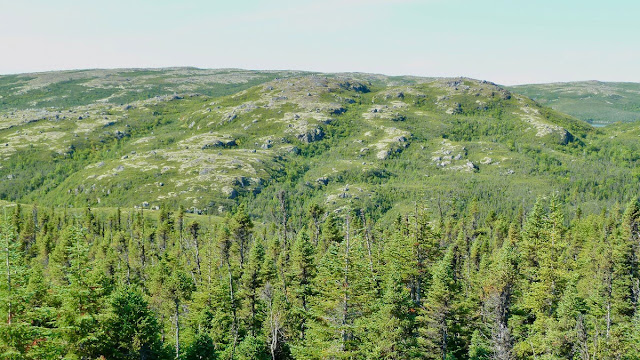 |
| The 1.4-billion-year-old rocks in Labrador, Canada, are some of the most well-studied remnants of Proterozoic mountains [Credit: Christopher Spencer] |
"So how do we reconcile the geological evidence for mountain building with the geochemical evidence for thin crust?" asked Christopher Spencer, a geologist at Queen's University in Ontario, Canada, and lead author of a new study published in Geophysical Research Letters.
Using a global database, Spencer et al. compared the rock record with the geochemical record from 1.8 billion to 850 million years ago, a period that begins about a billion and a half years after the earliest signs of life and ends 150 million years before complex life evolved. The geochemistry of continental rocks from that time suggests that the continental crust was thin (less than 40 kilometers) and hot—poor conditions for forming mountains.
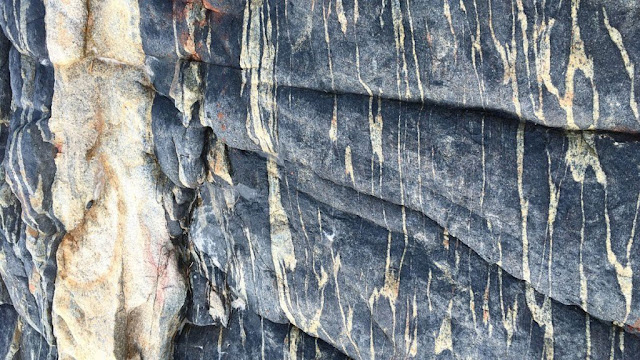 |
| Metamorphic rocks, like this 1.3-billion-year-old sample from Australia, provide insights into how ancient mountains formed [Credit: Christopher Spencer] |
Despite the hot crust, the mineral composition of rocks from around the world at that time suggests that there was significant crustal flow that resulted in lower mountain ranges. The process for building mountains under these unique conditions is something we've never seen on modern Earth or beyond, the authors suggest. "Mountains during the Proterozoic were different from mountains at any other time in Earth's history," Spencer said.
"Continental motion is possible without global plate tectonics," said Taras Gerya, a geophysicist from the Swiss Federal Institute of Technology (ETH Zurich) who was not involved in the study. According to Gerya, the authors "demonstrate that this period of time was indeed characterized by quite a special tectonic style, which is dissimilar to the present. So something really changed when we moved from the Proterozoic to Phanerozoic around 541 million years ago."
Author: Becca Dzombak | Source: EOS [October 07, 2021]
0 Comments